
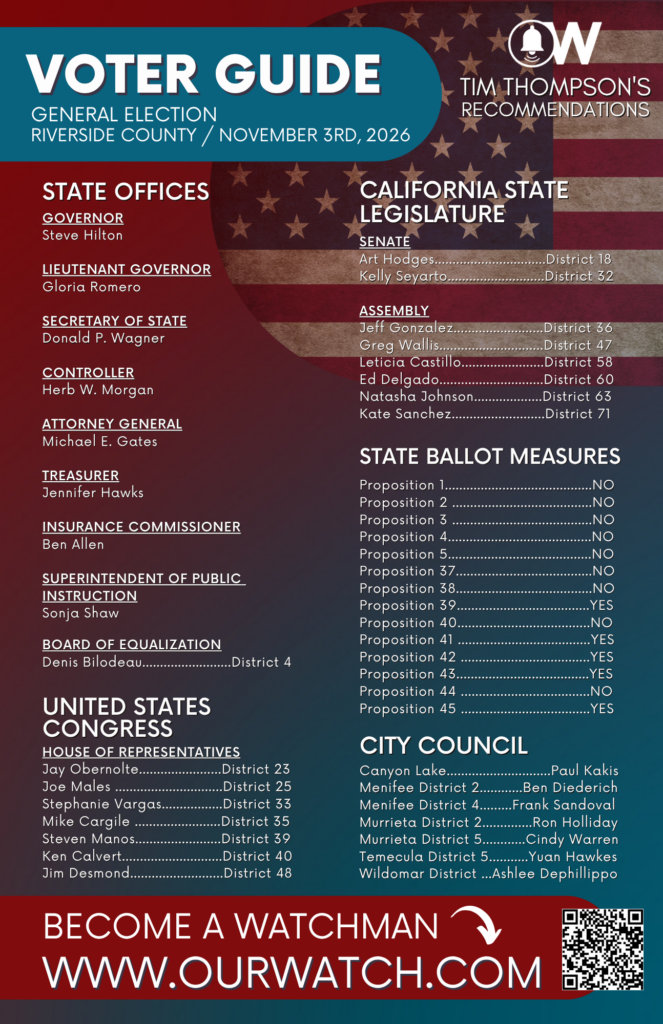
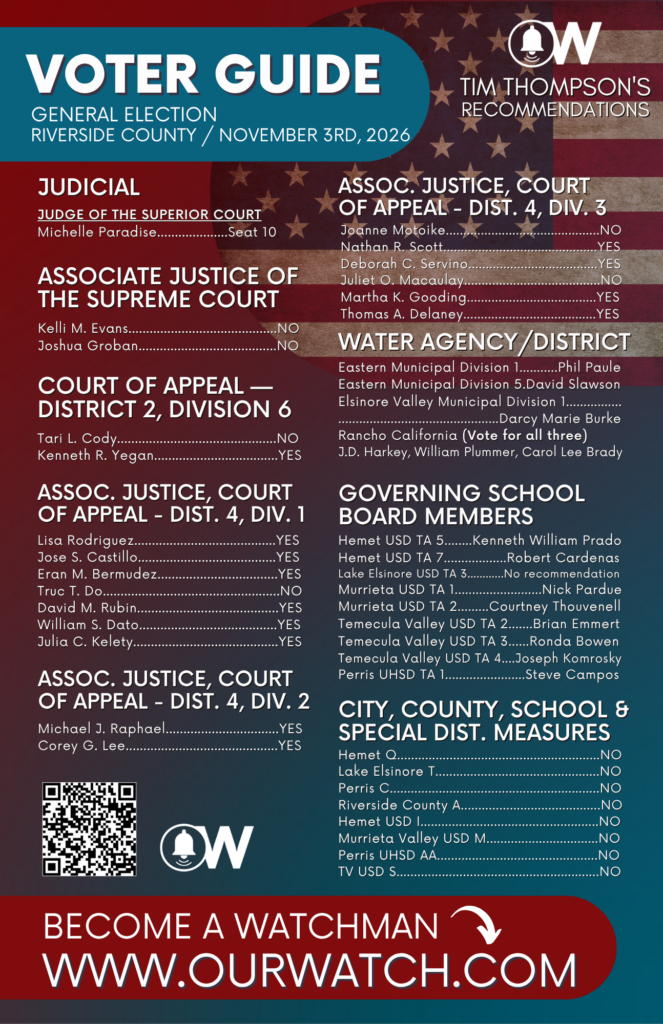
This voter guide helps California Christians navigate the November 3, 2026 election. Below you will find key races, ballot measures, biblical principles for civic engagement, and Pastor Tim Thompson’s teaching on why sitting out an election is not an option for believers. Download the full PDF voter guide here.
What the Bible Says About Voting
Scripture does not contain the word “vote,” but it speaks directly to the responsibilities that voting fulfills: seeking the welfare of your community, exercising stewardship over the freedoms God has granted, and standing as salt and light in a darkening world.
Matthew 5:13-16 “You are the salt of the earth… You are the light of the world. A city set on a hill cannot be hidden.” Jesus did not say believers could be salt and light. He said they are. That identity carries an obligation to engage wherever decay and darkness are advancing and that includes the ballot box.
Jeremiah 29:7 “Seek the welfare of the city where I have sent you into exile, and pray to the Lord on its behalf, for in its welfare you will find your welfare.” God’s people in Babylon were not told to withdraw. They were commanded to plant gardens, raise families, and actively contend for the good of the place they lived, even a hostile one.
Daniel 2:21 “He removes kings and sets up kings.” God is sovereign over every government. But in a constitutional republic, the way He exercises that sovereignty is through His people showing up and casting their vote.
1 Chronicles 12:32 The sons of Issachar “understood the times” and knew what Israel ought to do. Christians today are called to the same awareness: know what is happening, understand what is at stake, and act accordingly.
Why Christians Cannot Sit Out the 2026 Election
There are 25 million registered Christians in America who do not vote in federal elections. That is not neutrality, it is abdication.
When believers withdraw, the vacuum does not stay empty. It fills. School boards pass policies without a single Christian voice in the room. State legislatures advance laws that no one with a biblical worldview was present to oppose. As Pastor Tim puts it: “Nature abhors a vacuum. When you have Christians who are actively retreating… you’re seeding to the enemy and you’re allowing the gates of hell to grow stronger.”
The “lesser of two evils” argument is one of the most common reasons Christians give for staying home. No candidate and no party will be perfect scripture never promised they would be. The question is not whether a candidate meets every biblical standard. The question is whether you are meeting yours by engaging at all.
“We are citizens of Heaven, yes,” Tim says, “but we’re also citizens of Earth, and we are citizens of America, and we have to take that very seriously.”
2026 California Election: Key Dates and What Is on the Ballot
Election Day: Tuesday, November 3, 2026
Voter registration deadline: October 19, 2026 (online or by mail). Same-day registration is available at any polling place through Election Day.
Vote-by-mail: Every registered California voter receives a mail ballot automatically. Ballots must be postmarked by November 3 or dropped off at any official drop box by 8:00 p.m. on Election Day.
Key Races
Governor: Governor Newsom is termed out. This is the first open gubernatorial race in California since 2018.
State Legislature: All 80 Assembly seats and 20 of 40 Senate seats are on the ballot. Local races often have the most direct impact on issues Christians care about parental rights, school curriculum, religious liberty, and public safety.
Download the Full Voter Guide
Our Watch’s complete 2026 California Voter Guide is available as a free PDF. It includes every race, every ballot measure, and Pastor Tim’s reasoning behind each recommendation.
Download the November 2026 General Election Voter Guide (PDF)
What Pastor Tim Thompson Teaches About Christian Civic Duty
In his episode “What Is Your Role as a Christian as We Head Into a Presidential Election?” Pastor Tim and journalist Brittney Mayer lay out the biblical case for why disengagement is the one option Christians do not have.
Tim’s central argument is that the salt-and-light mandate in Matthew 5 is not optional and is not limited to church activities:
“Our role is to be Salt and Light. Salt is like to think of it as a disinfectant. It stops the putrid spread of cancers and disease. And then light goes into the shadows where the dark things hide and it shines sunshine onto those shadows. And that’s our calling.”
He draws a direct line from the Babylonian exile to the American ballot box. Daniel was second in command of all of Babylon. Shadrach, Meshach, and Abednego faced the fiery furnace rather than compromise. “These are the lessons we have to learn as Christians here in America,” Tim says. “We should never fear man more than we fear God.”
“God called us to occupy till he returns, which means we’re supposed to be busy, we’re supposed to be active. We live in a constitutional republic, and the way God brings about his sovereign will is by having his people show up and put their vote in.”
For Christians who say the political system is too corrupt to engage with, Tim’s answer is blunt:
“I think it’s a copout for Christians to sit this one out. We are called to be Salt and Light in every aspect and that includes politics.”
He closes with Jesus’ repeated command to watch to understand the signs of the times rather than consuming time with things that do not matter. “The sons of Issachar understood the times they were living in. Jesus said “watch, pay attention.”
Common Questions About Voting as a Christian
Should Christians vote if they do not like either candidate?
Yes. No candidate will perfectly reflect biblical values. Scripture calls you to steward the freedoms God has given you, not to wait for a perfect option. Evaluate which candidates and policies are most closely aligned with biblical principles, and vote accordingly.
Does the Bible command Christians to vote?
The Bible does not mention voting by name, but it commands believers to seek the welfare of their communities (Jeremiah 29:7), act as salt and light (Matthew 5:13-16), and submit to and participate in governing structures (Romans 13:1-7). In a republic where citizens choose their leaders, voting is how those commands are carried out.
Is it wrong to be a single-issue voter?
Some issues carry more moral weight than others. The sanctity of life, religious liberty, and the protection of children are areas where Scripture speaks clearly. It is not wrong to prioritize those issues when they are on the ballot.
How do I find my polling place in California?
Visit vote.ca.gov to find your nearest polling place or ballot drop-off location. You can also check your voter registration status, view a sample ballot, and track your mail-in ballot.
Can my church help me understand the ballot?
Yes. Churches are permitted to host voter registration drives, distribute nonpartisan voter guides, and teach biblical principles related to civic issues. A church cannot endorse a specific candidate from the pulpit, but it can and should equip its members to vote with a biblical worldview.
What if I have already missed the registration deadline?
California offers same-day voter registration. You can register and vote at any polling place in your county on Election Day, November 3, 2026. Bring a valid California ID or the last four digits of your Social Security number.
The 2026 election will shape California’s direction on the issues that matter most to Christian families: the protection of children, parental rights, religious freedom, and the sanctity of life. Your vote is not just a civic right. It is part of your calling.
Become a Watchman. Join the Our Watch community and stay informed through every election cycle.